



Dr. Kate Truitt & Associates, A Psychological Corporation

Related Resources

For Healing in a Crisis

An Introduction to the NeuroTriad Model

What if trauma responses were not signs of pathology, resistance, or brokenness — but intelligent adaptations shaped by the brain’s lifelong commitment to survival? In this educational introduction, Dr. Kate Truitt presents the NeuroTriad Model™ and the Brain Partnership™ Approach, a trauma-informed, neurobiologically based, and resilience-focused framework designed to help clinicians and clients understand how stress, trauma, and resilience live in the brain and body.

How to Build a Healthier Relationship with Difficult Emotions

We all have moments when our emotional world feels too big, too heavy, or too much. In this video, I’ll guide you through a trauma-informed framework for noticing, naming, and nurturing your emotions—so you can stop fighting them and start using them as data for healing.

A Guided Meditation to Rewire Your Brain for Confidence

One of the most profound ways we can advocate for ourselves is by believing in our capacity to grow, adapt, and heal. This confidence-building meditation is designed to help you reconnect with your strengths and rewire old narratives that say you’re not enough. Every breath becomes a vote for your worth.

Why Applied Neuroscience Belongs in the Trauma Therapy Room

By Dr. Kate Truitt

The science has moved forward. Trauma treatment deserves to move with it.

“I know I’m safe. So why is my body still reacting?”

If you treat trauma, you have probably heard some version of this question.

A client can know—intellectually—that the danger is over. They can know the person in front of them is safe, the door is unlocked, and they have choices now that they did not have then.

And still, their heart races. Their mind goes blank. Their muscles brace. They want to run, fight, appease, disappear, or simply stop feeling.

Too often, these moments are interpreted through the language of resistance, avoidance, or failure to “use the skills.”

Applied neuroscience gives us another question: What if the brain is doing exactly what it learned to do?

The Translational Lag: When Science Moves Faster Than Practice

Healthcare has a well-documented research-to-practice problem. You may have heard the frequently repeated estimate that it can take approximately 17 years for scientific knowledge to make its way into routine clinical care.

That number deserves nuance. Morris and colleagues (2011) found enormous variability in how translational lag is measured; there is no universal 17-year stopwatch. But the larger problem is real: what science has discovered and what reliably reaches day-to-day practice are not always the same thing.

Trauma treatment gives us a powerful example.

Contemporary neuroscience tells us that trauma is not housed in one “fear center.” Trauma-related disorders involve interacting neural systems responsible for detecting threat, contextualizing memory, regulating emotion, learning from experience, and determining what deserves our attention (Kredlow et al., 2022).

Stress also changes what is accessible to us in the moment. Under significant stress, prefrontal systems supporting working memory, cognitive flexibility, inhibition, and reflective decision-making can become less effective (Arnsten, 2009).

This is why a person can know they are safe while their brain and body continue to predict danger.

Insight and embodied access are not always the same thing.

Bringing the Brain Into the Room Changes the Question

Applied neuroscience moves us from:

“Why are you still doing this?”

to:

“What has your brain learned to predict here—and what is it trying to protect?”

A blank mind becomes more than “avoidance.”

Hypervigilance becomes more than “anxiety.”

An automatic urge to please becomes more than a “boundary problem.”

We begin to see these experiences in context: as organized adaptations that may once have supported safety, belonging, predictability, or agency.

That does not mean reducing a human being to their neural circuitry. Applied neuroscience should never become a new form of reductionism. And it does not replace trauma-focused psychotherapy.

It helps us become more precise inside it.

There is emerging evidence that successful trauma-focused psychotherapy is accompanied by changes in neural functioning, although findings remain heterogeneous and we still have much to learn about treatment-specific mechanisms (Manthey et al., 2021).

The brain is not separate from psychotherapy.

The brain is there for every moment of it.

And Then We Bring Our Brains Into the Room

There is another nervous system in every therapy session: ours.

Clinicians do not become biologically exempt from stress because we understand it.

When our own threat systems become activated, we can become urgent. Over-explain. Rescue. Push too quickly. Retreat from difficult material. Reach for a protocol because certainty feels safer than complexity.

Burnout among mental health professionals is associated not only with clinician well-being, but also with how clients engage with and benefit from psychotherapy (Yang & Hayes, 2020).

So clinician nervous-system awareness is not merely self-care.

It is part of clinical care.

This Is Where Translation Becomes Practice

Before asking a client to reinterpret a thought, challenge a belief, or approach painful material, we can become curious about state.

What is this nervous system predicting right now?

What is mine predicting?

What information is accessible—and what has temporarily gone offline?

What experience might offer this brain new evidence of safety, agency, connection, or choice?

I have spent much of my career living inside this translational question: not simply What does neuroscience tell us? but What does that science ask us to do differently in the next five minutes of a therapy session?

Because knowing that trauma changes the brain is not enough.

We need clinicians who know what to do with that information.


Let’s Close the Translational Gap Together

This fall and winter, I am opening several opportunities to learn applied neuroscience with me—from introductory clinical training to deeper certification pathways and immersive in-person work.

If you have been wanting to move beyond simply talking about the nervous system and begin learning how to work with the brain directly inside the therapy room, I would love to have you join us.


Because closing the translational lag does not happen when we memorize more brain regions.

It happens when better science changes what happens between two human beings in a room.

And that is the work I hope we will continue doing together.

Upcoming Applied Neuroscience Trainings

October 9–10, 2026 | NeuroTriad Model Two-Day Training — Kansas City Area
Join me in person in Olathe, Kansas, for two immersive days focused on the applied neurobiology of stress, trauma, self-organization, and resilience. We’ll move from neuroscience into case conceptualization, clinical intervention, experiential practice, and a pathway toward NeuroTriad Model certification.

October 15, 2026 | Applied Neuroscience for Trauma Therapists — Trauma Therapist Institute
A one-day live online clinical training devoted to a deceptively simple question: What do I actually do with neuroscience in my next session? We’ll translate threat processing, interoception, predictive patterns, autonomic regulation, and neuroplasticity into clinically usable interventions. Six continuing education credits are available.

October 24–November 22, 2026 | Applied Neuroscience for Trauma Healing Certificate — The Embody Lab
I’m joining Dr. Scott Lyons and Dr. Arielle Schwartz, along with additional faculty, for a three-weekend, 18-session exploration of the traumatized brain, sensory systems, memory, interoception, autonomic organization, and the integration of somatics with applied neuroscience.

SAVE THE DATE: November 3–4, 2026 | Free Two-Day Applied Neuroscience Training with PESI
Two full days exploring applied neuroscience for trauma recovery and posttraumatic growth, including the neurobiology of trauma and chronic stress, nervous-system regulation, memory, neuroplasticity, treatment planning, and practical clinical application. The training is CCTP certification-eligible. Registration information is coming soon–contact us to be the first to know when registration is open!

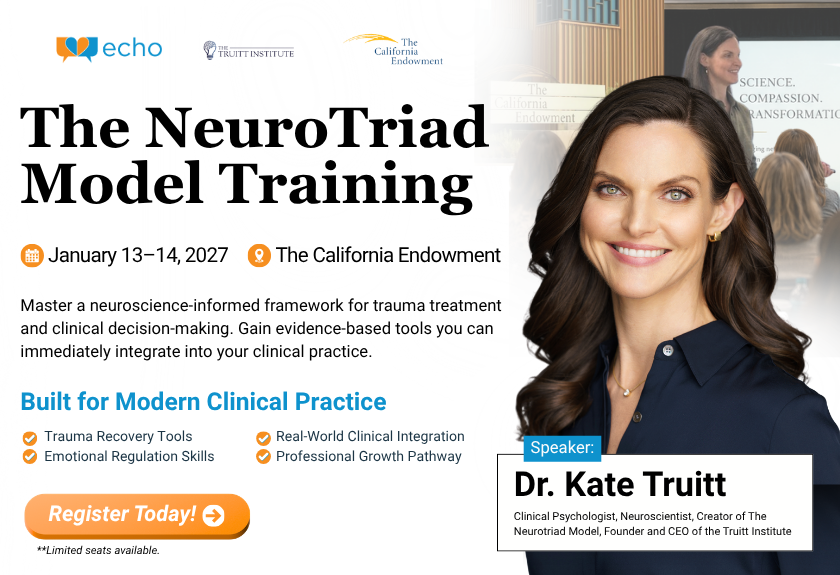
January 13–14, 2027 | NeuroTriad Model Training — Los Angeles

Come be with me in person at The California Endowment for an immersive two-day NeuroTriad Model training hosted by ECHO Trainings. We’ll work directly with the neuroscience of traumatic stress, regulation, resilience, and the practical clinical application of the model.

REFERENCES:

Arnsten, A. F. T. (2009). Stress signalling pathways that impair prefrontal cortex structure and function. Nature Reviews Neuroscience, 10(6), 410–422. https://doi.org/10.1038/nrn2648

Kredlow, M. A., Fenster, R. J., Laurent, E. S., Ressler, K. J., & Phelps, E. A. (2022). Prefrontal cortex, amygdala, and threat processing: Implications for PTSD. Neuropsychopharmacology, 47(1), 247–259. https://doi.org/10.1038/s41386-021-01155-7

Manthey, A., Sierk, A., Brakemeier, E.-L., Walter, H., & Daniels, J. K. (2021). Does trauma-focused psychotherapy change the brain? A systematic review of neural correlates of therapeutic gains in PTSD. European Journal of Psychotraumatology, 12(1), 1929025. https://doi.org/10.1080/20008198.2021.1929025

Morris, Z. S., Wooding, S., & Grant, J. (2011). The answer is 17 years, what is the question: Understanding time lags in translational research. Journal of the Royal Society of Medicine, 104(12), 510–520. https://doi.org/10.1258/jrsm.2011.110180

Yang, Y., & Hayes, J. A. (2020). Causes and consequences of burnout among mental health professionals: A practice-oriented review of recent empirical literature. Psychotherapy, 57(3), 426–436. https://doi.org/10.1037/pst0000317