Weird Grief Things That Are Actually Normal with Dr. Kate Truitt
Join Dr. Kate Truitt as she sheds light on the common symptoms of grief that can leave us feeling overwhelmed, broken, or lost. Grief is weird. But it doesn’t have to be,
A Guided Meditation for Cultivating Self Compassion on Your Grieving Journey
Welcome to this healing guided mindfulness meditation, where we combine the power of mindfulness and self-havening to nurture self-compassion during your traumatic grief recovery journey. In the midst of pain and loss, practicing self-compassion becomes a gentle balm for healing.
The Grief That Lives Alongside Love: A Holiday Gift for Dementia Caregivers
By Dr. Kate Truitt
The holidays have a way of bringing our most meaningful relationships into focus. And when someone we love is living with dementia, they can also bring an extraordinary combination of tenderness, gratitude, exhaustion, and grief.
I know this journey intimately.
My mom is living with Alzheimer’s disease. As a clinical psychologist, neuroscientist, and grief specialist, I’ve spent more than two decades helping people navigate trauma, loss, and the complexities of the human brain. Yet accompanying my own mother through Alzheimer’s has taught me things that no textbook or clinical experience ever could.
Dementia Caregiver Grief and Ambiguous Loss
I remember an evening when my mom came downstairs to the guest room where my husband and I were staying. When I opened the door, I saw fear in her eyes.
She didn’t recognize me.
I understood what was happening neurologically. I knew how to respond in a way that preserved her dignity and helped her feel safe. And afterward, I crawled into my husband’s arms and cried.
Because understanding the science doesn’t make it hurt less when it’s someone you love.
Dementia caregiving carries a particular kind of grief. We can miss aspects of a relationship even while the person we love is sitting right beside us. Researchers describe this experience as ambiguous loss, and grief before death is increasingly recognized as an important part of the dementia caregiving experience (Boss & Yeats, 2014; Crawley et al., 2023).
The Caregiver’s Own Brain Deserves Care
There’s another part of this journey we don’t talk about nearly enough: what happens to the caregiver’s own brain.
The constant vigilance, changing responsibilities, difficult decisions, and emotional demands of caregiving can take a substantial toll on well-being (Oliveira et al., 2024).
And somewhere along the way, caregivers can become so focused on protecting the person they love that their own needs quietly disappear from the care plan.
A Holiday Gift, From One Caregiver to Another
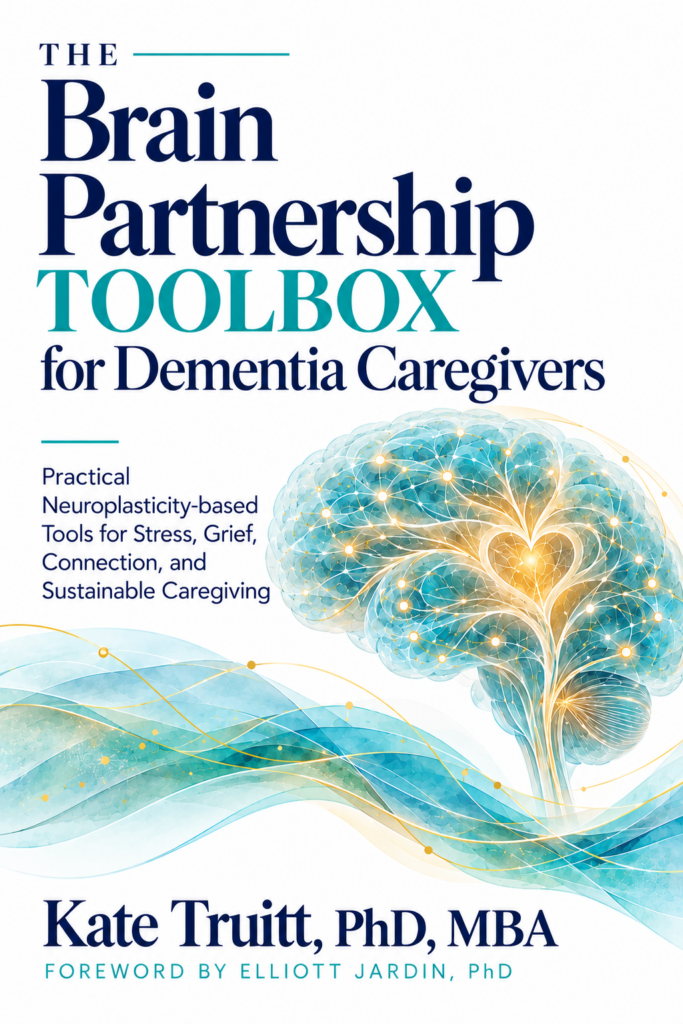
These experiences inspired my newest book, The Brain Partnership Toolbox for Dementia Caregivers: Practical Neuroplasticity-Based Tools for Stress, Grief, Connection, and Sustainable Caregiving.
I’ve woven together neuroscience, clinical wisdom, personal stories, and practical exercises to help caregivers understand their own stress responses, navigate grief, preserve meaningful connection, and build a more sustainable caregiving life (Truitt, 2026).
And because this book is so personal to me, I wanted to celebrate its release by giving something back to the caregiving community.
I’m sharing Chapter 1 as a free giveaway, so you can begin exploring the book and the Brain Partnership approach.
And for the limited-time holiday promotion, the entire Kindle edition is FREE on Amazon!
Whether you’re caring for a parent, partner, spouse, friend, or chosen family member, I hope this book offers a little more understanding, compassion, and practical support for the journey.
Because dementia caregiving involves two brains, one relationship, and a tremendous amount of love.
Both brains deserve care. ❤️
Support for Caregivers
If you are navigating caregiver stress, grief, or the emotional complexities of a changing relationship, our team at Dr. Kate Truitt & Associates offers specialized grief and loss therapy in Pasadena and via telehealth throughout California.
References
Boss, P., & Yeats, J. R. (2014). Ambiguous loss: A complicated type of grief when loved ones disappear. Bereavement Care, 33(2), 63–69. https://doi.org/10.1080/02682621.2014.933573
Crawley, S., Sampson, E. L., Moore, K. J., Kupeli, N., & West, E. (2023). Grief in family carers of people living with dementia: A systematic review. International Psychogeriatrics, 35(9), 477–508. https://doi.org/10.1017/S1041610221002787
Oliveira, D., da Mata, F. A. F., & Aubeeluck, A. (2024). Quality of life of family carers of people living with dementia: Review of systematic reviews of observational and intervention studies. British Medical Bulletin, 149(1), 1–12. https://doi.org/10.1093/bmb/ldad029
Truitt, K. (2026). The brain partnership toolbox for dementia caregivers: Practical neuroplasticity-based tools for stress, grief, connection, and sustainable caregiving. The Truitt Institute.
Like this post? Please share it with your colleagues & friends.